

Capterra offers objective, independent research and verified user reviews. We may earn a referral fee when you visit a vendor through our links.
Learn more
Our commitment
Independent research methodology
Capterra’s researchers use a mix of verified reviews, independent research and objective methodologies to bring you selection and ranking information you can trust. While we may earn a referral fee when you visit a provider through our links or speak to an advisor, this has no influence on our research or methodology. Learn more
How Capterra verifies reviews
Capterra carefully verified over 2.5 million+ reviews to bring you authentic software and services experiences from real users. Our human moderators verify that reviewers are real people and that reviews are authentic. They use leading tech to analyze text quality and to detect plagiarism and generative AI. Learn more
How Capterra ensures transparency
Capterra lists all providers across its website—not just those that pay us—so that users can make informed purchase decisions. Capterra is free for users. Software and service providers pay us for sponsored profiles to receive web traffic and sales opportunities. Sponsored profiles include a link-out icon that takes users to the provider’s website. Learn more
Human Resources Management Software
Human Resource software (or HR software), also known as Human Resources Management System (HRMS) or Human Resources Information System (HRIS), enables an organisation to manage employee records and information. The HR system allows you to organise contact details, department, attendance, salary, training, benefits, etc. Many HR tools and human resource management system software also interface with Applicant software and Payroll software. HR Management software or human resource management app is also related to Performance Appraisal software and Workforce Management software. Find top HR Software for your organisation in India. Read more Read less
The best HR software of 2025 for Indian businesses
A majority (59%) of Indian enterprises adopted HR software the preceding year, with 34% of companies leveraging these technologies for an even longer duration. However, just 7% of Indian organisations have yet to implement such solutions [a].
Indian businesses are increasingly recognising the strategic value of HR platforms. Notably, over a quarter (26%) of Indian companies have identified investment in an HR software tool as a high-priority initiative for 2025 [a].
Whether your organisation is new to HR management software or seeking to modernise its existing HR infrastructure, selecting the appropriate system can be complex. To assist you in this process, we have analysed 11,534 verified user reviews to present an overview of leading human resource management software options available in the Indian market. If these solutions do not precisely cater to your organisation's unique operational needs, we recommend consulting our detailed catalogue to identify the top HR software tailored to your requirements.
Top solutions

Rippling

Deel

Gusto

BambooHR

Paycor

Workday HCM
Zoho People

Keka

greytHR
How we picked the software on this list
Our independent and objective research is based on market demand signals in India along with an analysis of our proprietary data. This includes product information and verified user reviews in the last two years as of June 2025. Sponsorship or client status has no influence on the selection of products in the lists, but it may impact the order in which products appear. Read our full methodology.
Highly Rated for Payroll Management
Top rated feature:
Payroll Management
Starting Price:
No pricing found
Free trial
ADP Workforce Now is a comprehensive HR and payroll management solution with a 4.42 out of 5 rating from over 6,830 verified user reviews. It offers features such as payroll processing, benefits administration, time tracking, and employee self-service portals. The platform is designed for easy navigation and scalability, making it suitable for growing companies. Users appreciate its robust reporting capabilities, customisable dashboards, and practical compliance tools, which help streamline HR tasks and improve workforce management efficiency.
Features
-
Direct Deposit: Reviewers appreciate the ease of setting up and managing direct deposits, with the ability to split deposits across multiple accounts. Users value the control and timely access to funds, though initial account verification can be slow.
-
Payroll Management: Users find payroll management intuitive and efficient, with easy access to pay stubs and tax statements. Some note the interface feels outdated, but overall, it simplifies payroll tasks and reduces errors.
-
Payroll Reporting: Reviewers highlight the ease of generating and customising payroll reports, which are crucial for audits and budgeting. While some find it time-consuming to select the right report, the feature is generally praised for its accuracy and comprehensiveness.
-
Self-Service Portal: ADP Workforce Now users value the self-service portal for its convenience in accessing and updating personal information, reducing HR workload. Some find navigation challenging, but overall, it empowers employees to manage their data independently.
-
Payroll Document Preparation: Users appreciate the timely and easy access to payroll documents, which simplifies tax filing. The feature is praised for its convenience and reliability, though occasional software updates can cause temporary issues.
-
Tax Compliance: Reviewers find the tax compliance feature essential for ensuring accurate and timely tax filings. It simplifies complex tax calculations and informs users of regulatory changes.
Pros & cons
Pros:
Users appreciate ADP Workforce Now's comprehensive payroll management capabilities, simplifying calculations, tracking time, and tax deductions. The all-in-one platform integrates payroll, benefits administration, and time tracking, making it efficient and user-friendly. Employee management is also streamlined, with features that enhance accountability, transparency, and ease of access to critical information. The self-service portal allows employees to access pay stubs, request time off, and update personal information effortlessly. Tax management is simplified with easy access to payroll forms and other tax documents, which users find particularly helpful during tax season.
Cons:
However, users find the reporting features complex and challenging to navigate, often requiring additional support to generate custom reports. Updates and upgrades can be disruptive, with frequent changes that are not always well-communicated or thoroughly tested. Customer service is another significant concern, with users experiencing long wait times, inconsistent support, and difficulty resolving issues promptly. Website performance issues like slow loading times and browser compatibility concerns frustrate users.
Value for Money
638 reviews discussing Value for Money, 63% positive.
Reviewers have mixed opinions about the value of money for ADP Workforce Now. Many users appreciate the software's comprehensive features, such as easy access to payment information, tax documents, and employee benefits, which they find helpful for managing payroll and HR tasks efficiently. They also value the cost savings from automation and the ability to handle complex payroll processes, which can justify the expense for larger companies.
However, some users find the pricing structure high, especially for smaller businesses, and mention that the cost can be overwhelming due to the need to purchase multiple modules. Additionally, the lack of transparency in pricing and the need for frequent customer support, which can be slow and inconsistent, are common concerns. Users also note that the software can be complex to set up and use, which may require additional time and resources.
Popular Integrations
-
Microsoft Outlook: Users integrate ADP Workforce Now with Microsoft Outlook to sync time off requests and send automated email notifications, enhancing scheduling and communication. --- based on 13 reviews, 7 snippets.
-
MakeShift: Users integrate ADP Workforce Now with MakeShift to link scheduling with payroll, simplifying payroll processing and making it easier to use. --- based on 2 reviews, 2 snippets.
-
SAP Concur: Users integrate ADP Workforce Now with SAP Concur for expense tracking and management, streamlining financial operations. --- based on 2 reviews, 1 snippet.
-
Absorb LMS: Users integrate ADP Workforce Now with Absorb LMS to ensure employee compliance with LMS modules, facilitating module and development. --- based on 1 review, 1 snippet.
Highly Rated for Time Off Management
Top rated feature:
Onboarding Software
Starting Price:
CA$8.00/month
Free trial
Rippling holds a 4.87 out of 5 rating from over 3,924 verified user reviews, serving as an integrated platform for HR, payroll, IT, and finance management. Users highlight its ability to centralize tasks such as onboarding, payroll processing, benefits administration, time tracking, expense management, and device provisioning. The platform is noted for its automation, customizable workflows, and unified dashboard, supporting both employee self-service and administrative efficiency for organizations of varying sizes and structures.
Features
- Direct Deposit: Rippling users consistently highlight the ease and flexibility of setting up and managing direct deposit, including splitting paychecks across multiple accounts, timely notifications, and reliable on-time payments, though a few mention some confusion with dollar vs. percentage allocations.
- Payroll Management: Reviewers of Rippling value its intuitive payroll management, easy paystub access, and integration with time tracking, but some find the interface cluttered with pop-ups and note rare issues with expedited payroll and tax calculations.
- Payroll Reporting: Users appreciate Rippling’s detailed, intuitive payroll reporting with easy access to breakdowns, pay periods, and deductions, CSV exports, and integration with platforms like QBO, though some desire more customizable report options.
- Benefits Management: Rippling users find benefits management streamlined, with easy enrollment, plan comparisons, and centralized access, but some report setup confusion, calculation errors, and limited customer support for complex benefit schemes.
- Payroll Document Preparation: Reviewers highlight the simplicity and timeliness of payroll document preparation in Rippling, with easy online access, automated delivery, and reminders. However, some mention occasional issues with incorrect filings and the need for manual corrections.
- Tax Compliance: Users value Rippling’s automation and notifications for multi-state tax compliance, easy updates, and centralized document access, but some report challenges with state registrations, rare withholding errors, and slow customer support.
Pros & cons
Pros:
Reviewers consistently highlight Rippling’s ease of use, intuitive navigation, and streamlined interface, making daily HR tasks like managing payroll, benefits, and time off straightforward. Users appreciate having all employee management functions—such as onboarding, pay, and benefits—centralized in one platform, which saves time and reduces administrative hassle. The ability to access pay stubs, update personal information, and handle PTO requests efficiently is valued, especially for remote and global teams.
Cons:
However, users frequently mention frustrations with the login process, citing frequent logouts and cumbersome two-factor authentication. Reporting features are seen as limited and not user-friendly, and electronic signature tools lack flexibility.
Value for Money
262 reviews discussing Value for Money, 72% positive.
Most reviewers indicate that Rippling offers strong value for money by consolidating HR, payroll, benefits, and IT management into a single, user-friendly platform, which saves them significant time and reduces administrative costs. They appreciate the ability to customize modules, competitive pricing compared to other platforms, and cost-effective options for small businesses, including free access for very small teams. Users say the a la carte pricing allows them to pay only for what they need, though they note that adding features can increase costs. Some express concerns about opaque pricing, hidden fees, and escalating expenses as more modules are added.
Popular Integrations
- Slack: Users integrate Rippling with Slack to automate onboarding, manage user accounts, and streamline access to communication channels, especially for remote teams and daily collaboration. Based on 43 reviews, 26 snippets.
- Google Workspace: Integration with Google Workspace automates employee email provisioning, simplifies onboarding/offboarding, and ensures seamless account management for organizations using Google’s productivity tools. Based on 30 reviews, 16 snippets.
- Gmail: Users connect Rippling with Gmail to automate new employee account setup, streamline onboarding tasks, and centralize access to email and related systems for new hires. Based on 18 reviews, 7 snippets.
- Lattice: Rippling integrates with Lattice to import employee data, facilitate feedback processes, and connect HR information, supporting performance management and organizational development. Based on 16 reviews, 9 snippets.
Highest Rated
Top rated feature:
Performance Management
Starting Price:
$5.00/month
Free trial
Deel is a comprehensive HR platform with a 4.82 out of 5 rating from over 2,019 verified user reviews. It simplifies global hiring, onboarding, and payroll management by automating compliance, localised contracts, and multiple payment options. The platform supports various payment methods, including bank transfers, PayPal, and cryptocurrency, ensuring fast and flexible payments. Deel's intuitive interface and robust features make it suitable for managing international teams, ensuring compliance with local labour laws and tax regulations, and streamlining administrative tasks.
Features
-
Payroll Management: Reviewers appreciate its global payroll support, compliance, and automation but find the interface non-intuitive.
-
Electronic Signature: Users value its convenience, security, and efficiency for signing contracts remotely, enhancing the overall experience.
-
Multi-Country: Deel users highlight its ability to handle payments and compliance across multiple countries, supporting global operations.
-
Direct Deposit: Users find receiving payments directly into bank accounts convenient and reliable, though setting this up can be tricky.
-
Document Management: Reviewers like having all documents in one place, but some find it difficult to see complete contract updates.
-
Payroll Reporting: Users appreciate detailed, transparent reports on payments and deductions, aiding in financial management and transparency.
Pros & cons
Pros:
Users appreciate Deel for its robust payment management capabilities, offering a variety of payment methods, including bank transfers, PayPal, and cryptocurrency. This flexibility, with support for multiple currencies and compliance with local regulations, makes it ideal for businesses with remote teams. The platform's user-friendly interface and seamless integration with other financial tools simplify managing contracts and payments. Users also value the multiple withdrawal methods, such as Deel Instant Card transfers, PayPal, and Revolut, which cater to diverse needs and preferences.
Cons:
However, users express concerns about transaction fees, which can be high and impact overall cost-effectiveness, especially for smaller businesses. Deel cards are another issue, as they are not accessible in all countries, limiting their utility for some users. Additionally, users find email notifications excessive, sometimes irrelevant, annoying, and disruptive.
Value for Money
717 reviews discussing Value for Money, 79% positive.
Most users consider Deel an effective value for money due to its comprehensive features for managing international hiring and payroll. They appreciate the platform's flexibility in payment methods, including bank transfers, PayPal, and cryptocurrency, and its support for multiple currencies. Users find automated compliance, localised contracts, and transparent financial management particularly beneficial. They also value the fast payment processes, low commission rates, and real-time tracking of payments.
However, some users feel Deel's pricing can be high, especially for small businesses and startups. They mention occasional delays in payment processing and high fees associated with particular transactions and currency conversions. Some users also find the pricing structure somewhat complex and the fees for withdrawing money expensive.
Popular Integrations
-
PayPal: Users integrate Deel with PayPal for flexible and fast payment options, which many employees prefer for withdrawals and to manage money easily with various payment methods. --- based on 29 reviews, 25 snippets.
-
Payoneer: Users integrate Deel with Payoneer to transfer funds to local bank accounts, utilise Payoneer debit cards, and benefit from multiple withdrawal methods despite higher fees. --- based on 22 reviews, 18 snippets.
-
Xero: Users integrate Deel with Xero to simplify accounting, enhance efficiency, and reduce accounting errors through automated data synchronisation and easier payment reconciliation. --- based on 10 reviews, 3 snippets.
-
Coinbase: Users integrate Deel with Coinbase for cryptocurrency withdrawals despite high transfer fees and limited availability, especially for users outside the US. --- based on 9 reviews, 6 snippets.
Highly Rated for Compensation Management
Top rated feature:
Payroll Management
Starting Price:
$49.00/month
Free trial
Gusto holds a 4.63 out of 5 rating from over 4,074 verified user reviews and is recognized for its intuitive interface and comprehensive payroll and HR management features. Users highlight its automated payroll processing, tax filing, benefits administration, and employee self-service tools. The platform streamlines onboarding, time tracking, and document management, and integrates with various third-party applications, making it suitable for small to medium-sized businesses seeking an all-in-one HR and payroll solution.
Features
- Direct Deposit: Gusto users consistently highlight the ease and reliability of setting up and managing direct deposit, with timely payments, self-service options for updating bank info, and the ability to split deposits between accounts, though a few mention occasional delays or inconsistent deposit times.
- Payroll Reporting: Reviewers value Gusto’s detailed, easy-to-access payroll reports, customizable formats (PDF/CSV), and integration with QuickBooks, but some wish for more customization and admin visibility, and note rare syncing issues with agencies.
- Payroll Management: Users appreciate Gusto’s streamlined payroll management, auto-run for salaried staff, integration with time tracking, and ease of making changes, though some report frustrations with support and occasional delays in processing.
- Tax Compliance: Gusto users find tax compliance features helpful for automating filings and deductions across states, reducing manual effort and errors, but several reviewers note issues with multi-state taxes, delayed filings, and slow or unresponsive support when problems arise.
- Payroll Document Preparation: Reviewers of Gusto highlight the convenience and efficiency of automated payroll document preparation, early and easy employee access to forms, and reduced year-end hassle, though a few mention occasional support delays.
- Employee Database: Users like having a centralized, secure, and easily accessible employee database for onboarding, payroll, and HR tasks, though some mention search limitations and that it’s more useful for larger teams.
Pros & cons
Pros:
Reviewers consistently highlight Gusto’s ease of use, intuitive user interface, and streamlined payroll processing as major strengths, noting that both employers and employees find it simple to manage pay, benefits, and HR tasks. Users appreciate the ability to access paystubs, request time off, and handle employee management efficiently in one platform, with features like automated tax filing and direct deposit saving significant time.
Cons:
However, many users express frustration with limited and cumbersome reporting options, lack of a robust mobile app, and slow or inconsistent customer support, especially when urgent issues arise or complex questions need resolution.
Value for Money
920 reviews discussing Value for Money, 69% positive.
Reviewers say Gusto offers a user-friendly payroll and HR platform with a pricing model that scales based on the number of active employees, making it affordable for small businesses and startups. They appreciate the comprehensive features included in each plan, such as payroll processing, tax filings, benefits administration, and contractor payments, with options to add advanced tools at higher tiers. Users highlight free trial offers and referral incentives as added value. However, they note that costs can rise quickly as businesses grow or require more features, and some find the per-employee fees and higher-tier plans expensive or confusing.
Popular Integrations
- QuickBooks Online: Users integrate Gusto with QuickBooks Online to automate payroll data entry, ensure accurate financial records, and save time on manual payroll accounting tasks. Based on 38 reviews, 13 snippets.
- FreshBooks: Gusto integrates with FreshBooks to automatically sync payroll data, reduce manual entry, minimize errors, and streamline bookkeeping for small businesses and freelancers. Based on 12 reviews, 13 snippets.
- QuickBooks Time: Integrating Gusto with QuickBooks Time enables seamless transfer of approved employee hours and PTO for accurate, efficient payroll processing and reporting. Based on 6 reviews, 6 snippets.
Highly Rated for Sick Leave Tracking
Top rated feature:
Employee Management
Starting Price:
$10.00/month
Free trial
BambooHR is a comprehensive HR management software with a 4.59 out of 5 rating from over 2,941 verified user reviews. It centralises employee data, automates HR tasks, and enhances the employee experience with self-service options. Key features include onboarding, performance tracking, time-off, and document management. The platform is praised for its user-friendly interface and robust reporting tools, making it suitable for small to medium-sized businesses seeking to streamline HR processes and improve efficiency.
Features
-
Employee Database: Reviewers appreciate the centralised storage, customisation options, and advanced search features, though some find the org chart challenging to update.
-
Online Time Tracking: Users find it easy to clock in/out and track hours, but they note limitations like a lack of break tracking and detailed reporting.
-
HR Management: BambooHR users value centralised HR tasks, compliance tracking, and user-friendly interfaces, though some desire better module modules.
-
Vacation/Leave Tracking: Reviewers highlight the ease of requesting and tracking PTO, though some mention issues with syncing with payroll systems.
-
Time Off Management: Users appreciate the intuitive request and approval process, visibility of team availability, and integration with Google Workspace.
-
Online Time Clock: Reviewers find it easy to use for tracking hours, though some desire features like geo-fencing and automatic lunch deductions.
Pros & cons
Pros:
Reviewers appreciate BambooHR's comprehensive employee management capabilities, including easy access to employee profiles, time off requests, and organisational charts. The platform's user-friendly interface and centralised database streamline HR tasks, efficiently managing employee information, onboarding, and offboarding processes. Users also value the robust HR management features, simplifying tasks like time tracking, performance reviews, and document management. Additionally, BambooHR's customer support is frequently praised for being responsive and helpful, enhancing the overall user experience.
Cons:
However, users express concerns about payroll management, citing issues with integration, limited functionality, and complications with international payroll. The pricing structure is also a point of contention, with some finding it expensive, especially for smaller businesses. Reporting capabilities are another drawback, as users see them as limited and not customisable enough to meet specific needs.
Value for Money
359 reviews discussing Value for Money, 60% positive.
Reviewers have mixed opinions about BambooHR's value for money. They appreciate the software's comprehensive features, ease of use, and the availability of a free trial, which allows them to test its functionalities before committing. Users find it cost-effective for small to medium-sized businesses, offering a variety of HR capabilities at a competitive price. They also value the flexibility in pricing plans and the ability to grow without significant cost increases.
However, some users feel that BambooHR is expensive, especially for small businesses or those with limited budgets. They mention that the pricing structure can be confusing and that additional features often cost more. Some reviewers also note that the software lacks certain functionalities unless upgraded to more expensive plans, making it less accessible for smaller organisations.
Popular Integrations
-
Indeed: Users integrate BambooHR with Indeed to streamline job postings and recruitment processes, allowing direct posting to Indeed and better candidate tracking. --- based on 49 reviews, 33 snippets.
-
Slack: Users integrate BambooHR with Slack to streamline HR notifications, manage PTO requests, and improve workflow automation without switching between apps. --- based on 40 reviews, 24 snippets.
-
Google Calendar: Users integrate BambooHR with Google Calendar to automatically sync employee time off, sick days, and annual leave, improving visibility and planning. --- based on 30 reviews, 14 snippets.
-
Okta: Users integrate BambooHR with Okta for single sign-on and multifactor authentication, enhancing security and simplifying employee login processes. --- based on 15 reviews and 6 snippets.
Highly Rated for Employee Management
Top rated feature:
Payroll Management
Starting Price:
No pricing found
Free trial
Paycor holds a 4.36 out of 5 rating from over 2,958 verified user reviews and is recognized for its integrated platform supporting payroll, HR, benefits administration, and compliance. Users highlight its mobile accessibility, intuitive interface, and ability to streamline tasks such as onboarding, time tracking, and performance management. The software offers cloud-based management, customizable modules, and automated workflows, providing flexibility for both employers and employees to manage HR functions and payroll remotely and efficiently.
Features
- Direct Deposit: Paycor users consistently highlight the reliability, timeliness, and convenience of direct deposit, noting it simplifies payroll, reduces errors, and ensures employees are paid on time; setup is easy, though some mention unclear instructions for splitting deposits and desire for more app-based changes.
- Payroll Reporting: Reviewers value Paycor's customizable payroll reporting and easy access to detailed payroll data, but note frustrations with non-intuitive interfaces, limited historical data, frequent report errors, and the need for manual adjustments or support for custom reports.
- Payroll Management: Users appreciate Paycor's streamlined payroll management, automated calculations, and compliance support, making payroll processing faster and less error-prone, though some mention issues with deductions, shift differentials, and the need for frequent support when exceptions arise.
- Payroll Document Preparation: Reviewers find payroll document preparation fast, accurate, and mostly hands-off, with easy online access for employees. However, some mention challenges with reviewing documents before printing, address confirmation, and occasional difficulties accessing documents or correcting errors.
- Employee Database: Paycor users like the centralized, secure storage and easy access to employee data, supporting onboarding and payroll, though some report slow updates, navigation challenges, limited access for employees, and less robust reporting or cross-entity functionality.
- Tax Compliance: Reviewers appreciate Paycor's automated tax filing, timely payments, and integration with QuickBooks, but several report unresolved compliance issues, slow or unresponsive support, and occasional inaccuracies or manual intervention needed for complex tax scenarios.
Pros & cons
Pros:
Reviewers consistently highlight Paycor’s ease of use, noting its intuitive interface, customizable dashboards, and straightforward navigation for both administrators and employees. Users appreciate the seamless payroll processing, time tracking, and integrated HR management, which streamline daily operations and reduce administrative burdens. The employee self-service features, such as paystub access and time-off requests, are valued for promoting autonomy and efficiency. Support for questions and feedback is generally responsive and helpful.
Cons:
However, users frequently mention challenges with report generation, citing confusing interfaces and limited customization. Concerns also arise around inconsistent phone support, complex security protocols, and higher pricing compared to alternatives.
Value for Money
311 reviews discussing Value for Money, 65% positive.
Reviewers say Paycor offers a comprehensive set of payroll and HR features at a price they find affordable compared to many competitors, especially for small and mid-sized businesses. They appreciate bundled functionalities like payroll, HRIS, timekeeping, benefits administration, and reporting, with some free tutorials, webinars, and trial periods available. Users highlight time and cost savings, ease of use, and the ability to upgrade for more advanced needs. However, they note that many essential features require higher-tier plans or add-ons, making the total cost higher for small businesses. Some find frequent price increases, unclear billing, and extra fees for support or modules frustrating.
Highly Rated for Training Management
Top rated feature:
Benefits Management
Starting Price:
No pricing found
Free trial
Workday HCM is a comprehensive HR management platform with a 4.45 out of 5 rating from over 1,532 verified user reviews. It integrates HR functions such as payroll, benefits, talent management, workforce planning, and analytics into a single, cloud-based system. Users appreciate its user-friendly interface, real-time insights, and automation capabilities. The platform supports global operations and offers robust security features, making it suitable for medium to large organisations with complex HR needs.
Features
-
Direct Deposit: Reviewers highlight its convenience, security, and ease of setup, as well as its options for multiple accounts and real-time updates.
-
Vacation/Leave Tracking: Users appreciate its user-friendly interface for tracking, requesting, and approving leave, though some find it frustrating.
-
Payroll Reporting: Reviewers value customisable, real-time, and historical reporting, though some find the interface non-intuitive.
-
Time Off Management: Users find it easy to request, approve, and track time off, though some mention the need for better integration and speed.
-
Employee Management: Reviewers highlight comprehensive tools for onboarding, performance, talent, and compliance management, with all information in one place.
-
Payroll Management: Users appreciate streamlined processes, real-time insights, and compliance features, though some find it complex and non-intuitive.
Pros & cons
Pros:
Users appreciate Workday HCM's comprehensive HR management capabilities, combining payroll, benefits, talent management, and workforce planning into a single platform. The user-friendly interface and real-time analytics facilitate efficient HR processes and data-driven decisions. Employees benefit from self-service features, mobile accessibility, and the ability to manage their HR needs independently. The platform's integration capabilities and robust support make it suitable for large organisations, enhancing productivity and employee satisfaction.
Cons:
However, users find the submission process cumbersome, with issues like difficulty editing submitted information and a lack of intuitive navigation. Reporting features are often seen as complex and time-consuming, with delays in generating reports. The notification management system can be confusing, with redundant alerts and a lack of clarity. Additionally, the high cost of Workday HCM can be prohibitive for smaller organisations.
Value for Money
129 reviews discussing Value for Money, 55% positive.
Reviewers have mixed opinions about Workday HCM's value for money. On the positive side, users appreciate the comprehensive functionality and integration capabilities, which streamline HR processes and reduce external costs. They find the software efficient for managing expenses, payroll, and employee information, and they value the free trial option that allows them to explore the tool before committing. Some users mention that the long-term benefits and ROI justify the expense despite the high initial cost.
However, many reviewers highlight the high licensing, implementation, and module costs as significant drawbacks, particularly for smaller organisations. They also note hidden fees and the need for additional spending on modules and support. The system's complexity and the expensive mandatory module sessions are also points of concern. While some users find the investment worthwhile, others feel the costs are prohibitive and not fully transparent.
Highest Rated based in India
Top rated feature:
Applicant Tracking Software
Starting Price:
No pricing found
Free trial
Zoho People is an HR management tool with a 4.37 out of 5 rating from over 258 verified user reviews. It offers extensive HR functionalities such as attendance tracking, payroll integration, performance management, and automated workflows. The software is praised for its user-friendly interface, customisable features, and seamless integration with other Zoho products. While it is particularly beneficial for small and mid-sized businesses, it also supports larger organisations with its comprehensive tools and automation capabilities.
Features
-
Performance Review Management: Reviewers value the rating system, detailed reports, and goal tracking, though some find it complex.
-
Goal Setting/Tracking: Users appreciate the flexibility in setting and tracking goals despite some difficulties with OKR and KRA mapping.
-
Time Off Management: Zoho People users find it easy to manage time off, leave requests, and approvals with error correction options.
-
Employee Database: Reviewers highlight customisation, security, and easy access to comprehensive employee information.
-
Vacation/Leave Tracking: Users like the simple leave application process, balance tracking, and automated notifications.
-
Timesheet Management: Zoho People users find it effective for tracking work hours, with effective UX and easy report generation.
Pros & cons
Pros:
Users appreciate Zoho People's comprehensive employee management capabilities, which streamline communication and enhance engagement through a customisable self-service portal. The software simplifies HR processes, boosting team efficiency with its intuitive interface and integration with other Zoho apps. Form customisation is highly valued, allowing users to tailor forms and sections to their needs, saving time and reducing paperwork. The leave management feature is praised for its convenience and detailed tracking, making it easy for employees to manage their time off. The employee tracking functionality is also efficient, providing extensive records management and performance features.
Cons:
However, users find the mobile application lacking functionality and often glitchy, hindering the overall experience. The free trial and user access limitations can be restrictive, making it difficult to fully utilise the software without upgrading. Customer support receives criticism for being slow and unresponsive, which can be frustrating when issues arise. Lastly, the reporting capabilities are not intuitive or customisable, making it challenging to generate complex reports.
Value for Money
60 reviews discussing Value for Money, 82% positive.
Most users consider Zoho People to offer practical value for money, especially for small and mid-sized businesses. They appreciate its affordable and flexible pricing plans, with no hidden costs, and the availability of a free version that supports essential HR functions for small teams. Reviewers also highlight the cost-effectiveness of integrating Zoho People with other Zoho products and the availability of a free trial version. However, some users find the pricing steep for smaller businesses or startups and note that the free version has limited features. Additionally, some express concerns about the cost of third-party support services.
 Local product
Highly Rated for Ease of use
Top rated feature:
Onboarding Software
Starting Price:
$20.00/month
Free trial
Keka holds a 4.4 out of 5 rating from over 84 verified user reviews and is described as a comprehensive HR management platform offering payroll, attendance, leave management, performance tracking, and expense management in a single system. Users highlight its user-friendly interface, automation capabilities, customizable workflows, and streamlined onboarding. The software supports real-time reporting, compliance, and data security, and is noted for simplifying HR processes for both employees and managers through accessible dashboards and efficient task management.
Features
- Payroll Management: Reviewers highlight easy salary slip generation, detailed breakdowns, automatic deductions, and timely updates, though some report issues with salary calculation errors and tax computation inaccuracies.
- Attendance & Leave Tracking: Users appreciate the simple punch-in/punch-out process, real-time attendance tracking, leave management, and visibility into team availability, but some mention occasional glitches and issues with time logs.
- User Interface & Experience: Keka is praised for its intuitive and user-friendly interface, modern design, and easy navigation, though a few reviewers wish for further UI improvements.
- HR Automation & Customization: Reviewers value Keka’s robust automation for onboarding, payroll, and HR tasks, as well as comprehensive features and customization options. However, some note limitations in flexibility and challenges with integrations.
- Employee Database & Self-Service: Users like the centralized and secure employee database, easy access to employee details, and self-service options for payroll and HR information, though some report slow updates and limited reporting for employees.
- Performance & Analytics: Keka is recognized for its analytics and data visualization for performance management, payroll, and attendance, but some users desire improvements in performance tracking and easier report fetching.
Pros & cons
Pros:
Reviewers appreciate Keka’s comprehensive and customizable features, highlighting its user-friendly interface and clean design that simplify navigation and daily HR tasks. Users find attendance tracking intuitive, with easy access to time logs, leave balances, and remote attendance options, which streamlines workflow for both employees and managers. Employee management tools, including performance analytics and feedback forms, help organizations improve efficiency and internal structure. Many mention the platform’s ease of use, requiring minimal training, and praise the straightforward, uncluttered user interface.
Cons:
However, users frequently report slow and unresponsive customer support, mobile app limitations and bugs, and challenges with expense tracking accuracy.
Value for Money
17 reviews discussing Value for Money, 54% positive.
Reviewers say Keka offers a wide range of features—such as time tracking, payroll management, expense management, and leave tracking—at a price they find reasonable compared to competitors. They appreciate the comprehensive functionality included in the base cost and highlight the platform’s competitive pricing and feature set as key benefits. However, they mention that Keka can be expensive for smaller companies and startups, and some feel the service does not always justify the price. Users also express dissatisfaction with the misleading free trial, describing it as a limited demo with fake data.
Local product
Highly Rated & Free
Top rated feature:
Performance Management
Starting Price:
$26.15/month
Free trial
greytHR is a comprehensive HR management software with a 4.31 out of 5 rating from over 278 verified user reviews. It offers automated payroll processing, leaves and attendance management, employee self-service, and compliance with Indian labor laws. The platform is praised for its user-friendly interface and ability to streamline HR processes, making it suitable for small businesses and larger enterprises. Users appreciate its efficiency in handling various HR tasks and responsive customer support.
Features
-
Payroll Management: Reviewers appreciate its simplicity, accuracy, and time-saving automation, though some mention the need for regular updates.
-
Employee Database: Users value centralised data storage and easy access, but some find report generation and data retrieval cumbersome.
-
Payroll Reporting: Reviewers highlight its comprehensive financial summaries and customisation options, though some desire better integration with QuickBooks.
-
Employee Profiles: Users find registering and maintaining accurate details easy, but some suggest improvements for better confidentiality.
-
Tax Compliance: Reviewers appreciate automated calculations and compliance adherence, though some seek improvements in user-friendliness and additional features.
-
Time & Attendance: Users find it effective for monitoring and payroll integration, and it has a good user interface, though some do not use it.
Pros & cons
Pros:
Users appreciate greytHR's comprehensive HR management capabilities, including payroll, attendance, and leave management. The platform's user-friendly interface and robust features streamline HR processes, making onboarding, offboarding, and compliance management more efficient. The support team is responsive and helpful, enhancing the overall user experience. Regular updates and improvements keep the software relevant and user-friendly.
Cons:
However, users note some drawbacks. Management updates can be confusing and lack proper guidance. The leave management system is not always intuitive, and multi-level approval is missing. Ticket resolution can be slow, and the user interface feels outdated and cluttered. Performance lags and occasional crashes also affect usability.
Value for Money
32 reviews discussing Value for Money, 73% positive.
Most users consider greytHR to offer great value for money due to its comprehensive features like leave management, payroll, attendance tracking, and expense claims, all at an affordable price. They appreciate the intuitive interface, responsive support, and regular updates that keep the software compliant with statutory changes. Many find it budget-friendly, even for startups, and note that it is cheaper than its competition.
However, some reviewers feel that the tiered pricing model may not suit companies with more straightforward HR needs and mention subscription cancellation and invoicing issues. A few also find specific modules, like reimbursement, not user-friendly or consider the software expensive for the features provided.
Our full directory of Human Resources Management Software solutions
Filter Results (1591)
Countries available
Show more details
Countries where the product is available. Note: Customer support may not be accessible in that country.
India
Pricing Options
Product type
1591 results
Zigtal helps organizations accelerate business growth driven by skills. Align skill strategy with business strategy.
Learn more about Zigtal
Accelerate growth by using skill as fuel.
Skill Intelligence platform helps you to understand your skill landscape, fast business decisions based on current capabilities and future potential, nurture talent using internal coaching, mentoring, gigs and leaders hub.
Learn more about Zigtal
...
Read more
Features
- Performance Management
- Applicant Tracking Software
- Compensation Management Software
- Employee Management
- Recruitment Management
- Benefits Management
- Time & Attendance
- Payroll Management
- Onboarding Software
Cloud-based and AI-enabled human capital management solution that offers payroll, HR, and workforce management features for businesses.
ADP Workforce Now is a cloud-based and AI-enables workforce management software that assists with human resources management, payroll, benefits, talent management, compliance, time & labor management, analytics & benchmarking.
The fully integrated suite is built on a single database, which automates data synchronization across different components and helps users to minimize manual administrative tasks. The platform also integrates with other HR and business applications via the ADP Marketplace and APIs.
Learn more about ADP Workforce Now
...
Read more
Features
- Performance Management
- Applicant Tracking Software
- Compensation Management Software
- Employee Management
- Recruitment Management
- Benefits Management
- Time & Attendance
- Payroll Management
- Onboarding Software
Time tracking and employee scheduling solution that helps businesses schedule jobs, coordinate teams, track time and track projects.
QuickBooks Time is a cloud-based time tracking solution, seamlessly connecting with leading accounting tools, such as QuickBooks Online, ADP and more. Administrators can manage people, projects and payroll, all via a unifed platform. The platform offers scheduling tools for managers to create and share schedules by jobs or shifts. It integrates with various accounting and payroll systems, syncing data to reduce errors and automate payroll. Customizable reports provide insights into productivity and job costs, aiding informed decisions. The activity feed enables real-time updates and project tracking. With its user-friendly interface and robust integrations, QuickBooks Time helps businesses efficiently manage their workforce and reduce administrative tasks.
Learn more about QuickBooks Time
...
Read more
Features
- Performance Management
- Applicant Tracking Software
- Compensation Management Software
- Employee Management
- Recruitment Management
- Benefits Management
- Time & Attendance
- Payroll Management
- Onboarding Software

AI-assisted career transition and job search with Fit Scores, tailored applications, market reports, pipeline tracking and professional workspaces.
JobViseur is an AI-assisted career transition and job-search platform for job seekers, career coaches, outplacement providers, employability organizations and higher-education career services. It combines multi-source job discovery, profile-to-role Fit Scores, detailed job analysis, tailored CV and application email generation, application tracking and market-positioning reports. Users can compare opportunities against their profile, identify strengths, skill gaps and blocking requirements, prepare targeted applications and track progress from saved roles to interviews and offers. Professional plans add beneficiary sub-accounts, shared credits, multi-client management and custom branding. JobViseur is particularly relevant to France and Switzerland while also surfacing international opportunities through aggregated job sources.
Learn more about monday AI Work Platform
...
Read more
Features
- Performance Management
- Applicant Tracking Software
- Compensation Management Software
- Employee Management
- Recruitment Management
- Benefits Management
- Time & Attendance
- Payroll Management
- Onboarding Software

HR for Frontline Teams - Records, PTO, Training, Time Tracking & Employee Self-Service
Stop managing HR with scattered spreadsheets, paper forms, missed updates, and disconnected tools. Connecteam gives businesses one easy mobile app to manage employee records, onboarding, documents, PTO, training, time tracking, scheduling, tasks, and team communication. Employees can request time off, complete training, access documents, view schedules, and stay connected from their phones, while managers get better visibility into attendance, compliance, documents, training progress, and daily workforce activity. Built for frontline, deskless, and shift-based teams, Connecteam helps reduce admin work, improve accountability, simplify HR processes, and keep every employee connected. Start your 14-day free trial.
Learn more about Connecteam
...
Read more
Features
- Performance Management
- Applicant Tracking Software
- Compensation Management Software
- Employee Management
- Recruitment Management
- Benefits Management
- Time & Attendance
- Payroll Management
- Onboarding Software
Run your workforce on the #1 rated HR system. HR, IT, spend & payroll made easy. All-in-one support for your global business.
Run your workforce on the #1 rated HR system. With Rippling, you can automatically sync employee updates to payroll, onboard and offboard employees in 90 seconds, and access all your employee data in one place. Simplify HR management and enhance efficiency with a unified system that makes employee administration seamless.
Learn more about Rippling
...
Read more
Features
- Performance Management
- Applicant Tracking Software
- Compensation Management Software
- Employee Management
- Recruitment Management
- Benefits Management
- Time & Attendance
- Payroll Management
- Onboarding Software

ClickUp is the world’s first Converged AI Workspace, bringing together all work apps, data, and workflows.
ClickUp is the world’s first Converged AI Workspace, bringing together all work apps, data, and workflows. ClickUp eliminates all forms of work sprawl to provide 100% context and a single place for humans and agents to work, together. Trusted by more than 20 million users worldwide, ClickUp is on a mission to maximize human productivity.
Learn more about ClickUp
...
Read more
Features
- Performance Management
- Applicant Tracking Software
- Compensation Management Software
- Employee Management
- Recruitment Management
- Benefits Management
- Time & Attendance
- Payroll Management
- Onboarding Software
From onboarding to offboarding, manage every worker type with built-in compliance, payroll, IT, and more. All in one place.
Deel HR is an all-in-one suite to manage the full worker lifecycle for global teams in 150+ countries. Bring direct hires, contractors, and EOR workers into one system with profiles, org charts, documents, and role-based access. Turn onboarding, changes, and offboarding into workflows with approvals, tasks, and reminders. Handle IT needs too, like equipment and app access, so laptops and logins are ready for day one. Run time off and time tracking, support payroll and benefits, and stay on top of local rules with built-in compliance guardrails. Keep teams engaged with surveys, learning and policy training, and performance cycles. Use reporting and analytics to track headcount, costs, and trends, with exports when you need to share
Learn more about Deel
...
Read more
Features
- Performance Management
- Applicant Tracking Software
- Compensation Management Software
- Employee Management
- Recruitment Management
- Benefits Management
- Time & Attendance
- Payroll Management
- Onboarding Software
Gusto is the all-in-one HR & payroll platform for growing businesses—one place to hire, pay, insure, and manage your hardworking team.
Gusto's automated HR software can help you build your dream team. No jumping between systems, no compliance confusion, and no stress.
Whether you’re just getting started or scaling your fast-growing business, Gusto is the partner you need to grow and nurture your team. With Gusto, you get modern HR features like payroll, benefits, hiring, management resources, and more — all in one place.
Gusto is proud to serve more than 500,000 businesses across the US with a single trusted system, competitive compensation tools, and expert guidance to help you empower your team. Because when your people thrive, your business thrives too.
Learn more about Gusto
...
Read more
Features
- Performance Management
- Applicant Tracking Software
- Compensation Management Software
- Employee Management
- Recruitment Management
- Benefits Management
- Time & Attendance
- Payroll Management
- Onboarding Software
BambooHR is an award-winning HR platform that helps your growing organizations automate, centralize, and connect your people data.
The BambooHR all-in-one platform gives your growing organization the foundation it needs to build a thriving workplace now and far into the future. It brings together best-in-class solutions, capabilities, and integrations in one place, with a single source of data, so you can directly impact the employee experience while managing the tasks, workflows, and reporting that keep HR running.
When the hardest part isn't doing the work but deciding what's right, HR Consulting gives you a consultant who knows HR strategy and knows your BambooHR setup. You get guidance on the decision and help getting it built into your account, from the same partner.
Learn more about BambooHR
...
Read more
Features
- Performance Management
- Applicant Tracking Software
- Compensation Management Software
- Employee Management
- Recruitment Management
- Benefits Management
- Time & Attendance
- Payroll Management
- Onboarding Software
Streamline HR, automate admin, enhance communication, and drive efficiencies with a unified and user-friendly platform.
User-friendly Paycor HR automates admin, streamlines communication, and drives efficiencies. With features like unified employee data storage, enhanced communication tools, insights into manager effectiveness, automated workflows, paperless document management, and robust reporting & analytics, Paycor HR empowers leaders to provide strategic insights, proactive people management, and compliance adherence. And now Paycor, a Paychex company, delivers the most comprehensive, flexible, and innovative HCM solutions for HR leaders seeking both technology excellence and specialized HR guidance. The powerful combination of Paycor and Paychex transforms your role from process manager to business strategist, delivering data-driven insights that directly impact business outcomes.
Learn more about Paycor
...
Read more
Features
- Performance Management
- Applicant Tracking Software
- Compensation Management Software
- Employee Management
- Recruitment Management
- Benefits Management
- Time & Attendance
- Payroll Management
- Onboarding Software

Wrike is the secure, AI-powered work management platform for HR to manage onboarding, performance reviews, and key projects.
Wrike is the trusted work delivery platform for Human Resources, where AI extends what your HR team can accomplish. By centralizing HR processes like onboarding and performance reviews in one governed, secure environment, Wrike helps organizations streamline collaboration, project planning, and task execution while maintaining the control and confidentiality required. Key features include AI Agents, Wrike Copilot, workflow automations for checklists, customizable dashboards for tracking KPIs, real-time collaboration tools, and advanced reporting. More than 20,000 organizations worldwide trust Wrike to manage their most important people operations.
Learn more about Wrike
...
Read more
Features
- Performance Management
- Applicant Tracking Software
- Compensation Management Software
- Employee Management
- Recruitment Management
- Benefits Management
- Time & Attendance
- Payroll Management
- Onboarding Software

Employee experience platform with recognition, rewards, surveys, and insights that improve engagement and retention.
Achievers is an employee engagement platform that helps organizations improve productivity, retention, and workplace culture through recognition, rewards, employee listening, and actionable workforce insights.
The platform enables employees and managers to recognize great work, celebrate milestones, participate in surveys, and provide feedback that helps organizations understand and improve the employee experience. Achievers combines peer-to-peer recognition, a global rewards marketplace, Voice of Employee tools, and AI-powered insights to drive higher participation and stronger employee connections.
Built for mid-sized and enterprise organizations, Achievers supports distributed and global workforces with integrations across leading HR and collaboration platforms including Microsoft Teams, Outlook, Workday, UKG, SAP SuccessFactors, ADP, BambooHR, and Slack.
Learn more about Achievers
...
Read more
Features
- Performance Management
- Applicant Tracking Software
- Compensation Management Software
- Employee Management
- Recruitment Management
- Benefits Management
- Time & Attendance
- Payroll Management
- Onboarding Software

NetSuite is the AI-powered cloud ERP that unifies financials and operations to help businesses grow and scale.
NetSuite is the #1 AI-powered cloud ERP, helping organizations streamline operations, improve visibility, and accelerate growth on a single, integrated cloud business suite. Designed to grow with your business, NetSuite brings together accounting, inventory and order management, procurement, CRM, human resources, commerce, and more. Ask Oracle enables users to interact with NetSuite through natural language by answering questions, analyzing business data, surfacing insights, and providing guidance-all within NetSuite’s existing security, roles, permissions, and controls. Embedded into everyday workflows, Ask Oracle helps users make faster, more informed decisions and take action without disrupting their work. Agents and agentic workflows extend these capabilities by automating tasks & coordinating work across multiple steps. Supporting more than 44,000 organizations in over 220 countries and territories, NetSuite provides the scalability, flexibility, and intelligence businesses need.
Learn more about NetSuite
...
Read more
Features
- Performance Management
- Applicant Tracking Software
- Compensation Management Software
- Employee Management
- Recruitment Management
- Benefits Management
- Time & Attendance
- Payroll Management
- Onboarding Software

Paylocity's all-in-one HR software helps you shift from admin tasks to strategic growth. Centralize employee data and automate onboardi
Tired of juggling disconnected systems for HR, Finance, and IT? Wasted time and manual work slow your business down. Paylocity is the one unified platform that brings it all together.
We connect your people, processes, and data in a single, modern system. Automate tedious tasks, from onboarding and payroll to spend management and IT. Break down silos so your teams can collaborate better and make smarter decisions.
Our platform gives you the clear insights you need to stay agile and drive real results. For HR, it means less paperwork and more time for your people. For Finance, it's better control and visibility over spending. For IT, it's streamlined processes and secure data.
Stop the inefficiencies. Start unifying your business with a platform built to move you forward, together. Paylocity helps you spend less time on tasks and more time driving growth.
Learn more about Paylocity
...
Read more
Features
- Performance Management
- Applicant Tracking Software
- Compensation Management Software
- Employee Management
- Recruitment Management
- Benefits Management
- Time & Attendance
- Payroll Management
- Onboarding Software
Workday HCM helps master the transition to a new era of work, with a comprehensive global HR suite for core HR, talent, and benefits.
Workday is an enterprise platform that helps organizations manage their assets – their people and money. The Workday platform is built with AI at the core to help customers elevate people, supercharge work, and move forever forward.
Workday Human Capital Management (HCM) is the Workday application suite for HR.
Learn more about Workday HCM
...
Read more
Features
- Performance Management
- Applicant Tracking Software
- Compensation Management Software
- Employee Management
- Recruitment Management
- Benefits Management
- Time & Attendance
- Payroll Management
- Onboarding Software

Accounting solution that helps businesses automate invoicing, payroll management, estimating, invoicing, and bookkeeping tasks.
With Wave’s small business software, users can automate bookkeeping tasks, create invoices and simplify tax preparation. It offers bookkeeping tools from within a unified platform. The platform streamlines decision-making through financial reports. Users can track payments, view customer information, and manage cash flow with the dashboard and mobile application.
Learn more about Wave
...
Read more
Features
- Performance Management
- Applicant Tracking Software
- Compensation Management Software
- Employee Management
- Recruitment Management
- Benefits Management
- Time & Attendance
- Payroll Management
- Onboarding Software

Simplify HR with ADP®. Hire, onboard, track time and effortlessly manage teams, all with expert support.
RUN Powered by ADP® helps businesses take care of their people from day one and every day after. User-friendly HR tools simplify hiring, onboarding and team management, allowing organizations to focus on growth rather than paperwork.
Businesses gain peace of mind with expert HR and payroll support available whenever assistance is needed. Recruiting, onboarding, compliance training and employee handbooks can all be managed in one place. Benefits such as insurance and retirement plans can be offered with minimal effort, while automated time tracking eliminates manual timecards and enhances efficiency.
Teams remain engaged through flexible pay options, a built-in employee discount program and an intuitive mobile payroll and HR app designed for ease of use. Data-driven salary benchmarking provides valuable insights to help businesses stay competitive in the current hiring market.
RUN Powered by ADP® delivers smarter HR solutions for small businesses that prioritize their people.
Learn more about RUN Powered by ADP
...
Read more
Features
- Performance Management
- Applicant Tracking Software
- Compensation Management Software
- Employee Management
- Recruitment Management
- Benefits Management
- Time & Attendance
- Payroll Management
- Onboarding Software

Employees have already been managing their own timecards, expenses, PTO, benefits and more. Now they can do their own payroll, too.
Paycom provides user-friendly HR and employee-driven payroll technology to enhance the entire employee life cycle, all in a single software. From onboarding and benefits enrollment to talent management and more, Paycom streamlines processes, drives efficiencies, increases data integrity and gives employees power over their own HR information.
Learn more about Paycom
...
Read more
Features
- Performance Management
- Applicant Tracking Software
- Compensation Management Software
- Employee Management
- Recruitment Management
- Benefits Management
- Time & Attendance
- Payroll Management
- Onboarding Software
Designed to help HR professionals with hiring, employee management, expense management, appraisal management, and any other HR need.
Odoo HR is a fully integrated, completely customizable app that helps HR professionals with hiring, employee management, expense management, appraisal management, and other human resource needs. Users can change job positions, stages, medium, priority, and responsibility in the list view, as well as create reports on reasons why applicants weren¿t hired. Companies can quickly automate HR processes with the easy-to-use Odoo suite of HR apps.
Learn more about Odoo
...
Read more
Features
- Performance Management
- Applicant Tracking Software
- Compensation Management Software
- Employee Management
- Recruitment Management
- Benefits Management
- Time & Attendance
- Payroll Management
- Onboarding Software
AI-powered ATS that automates sourcing, matching, and candidate engagement for staffing firms and healthcare agencies.
Ceipal ATS is an AI-powered applicant tracking system built for staffing firms, healthcare agencies, and corporate recruiting teams. It automatically sources, ranks, and engages candidates across 200+ integrations, cutting manual sourcing effort significantly. Built-in CRM, email, SMS, and Voice AI keep candidate and client communication centralized. Workflow automation handles scheduling, document collection, and status updates. Healthcare teams get real-time credentialing, license verification, and 120+ specialty assessments built in. Customizable dashboards track time-to-fill, pipeline health, and revenue metrics. Natively integrated with Ceipal Workforce and Procurewise, data flows from hire to placement to invoicing seamlessly. SOC 2 Type 2 compliant, trusted by 200,000+ recruiters globally.
Learn more about CEIPAL ATS
...
Read more
Features
- Performance Management
- Applicant Tracking Software
- Compensation Management Software
- Employee Management
- Recruitment Management
- Benefits Management
- Time & Attendance
- Payroll Management
- Onboarding Software

Cloud-based document workflow tool for creating, sending, signing, and managing proposals, contracts, and quotes with e-signatures.
PandaDoc is a cloud-based document workflow platform that helps businesses create, send, sign, track, and manage documents in one place. Teams use it to build proposals, contracts, quotes, and forms using a drag-and-drop editor with reusable templates and a content library.
PandaDoc supports legally binding e-signatures, real-time document tracking, and payment collection, giving businesses visibility into where documents stand at every stage. Approval workflows and CRM integrations help keep sales and operations teams aligned.
PandaDoc is best suited for small to midsize businesses in sales, marketing, legal, and HR roles, though it also scales for larger organizations that need to manage high volumes of documents across teams.
Learn more about PandaDoc
...
Read more
Features
- Performance Management
- Applicant Tracking Software
- Compensation Management Software
- Employee Management
- Recruitment Management
- Benefits Management
- Time & Attendance
- Payroll Management
- Onboarding Software

7shifts is the HR platform for restaurants helping operators hire, train, schedule, pay, and retain their team in one place.
7shifts believes that employees are the driving force behind the success of restaurants and they are committed to elevating the standards of what restaurant teams can accomplish together.
Born in the back office of a sandwich shop, 7shifts was founded in 2014 with the goal of building simple solutions to solve the most complex team management challenges.
Today 7shifts is the HR platform for restaurants helping operators hire, train, schedule, pay, and retain their team in one place. With an easy-to-use platform and built-for-restaurant workflows, 7shifts replaces disconnected systems for 55,000 restaurants.
Here’s how your restaurant can benefit from 7shifts:
-Save up to 4 hours per week creating and managing your staff schedules
-Reduce time spent on scheduling by 80%
-Save up to $250 per month in managers' time
-Reduce labor costs to save up to $3,000 annually
-Reduce calls and texts from staff by 70%
-Create schedules with 95% labor accuracy
Learn more about 7shifts
...
Read more
Features
- Performance Management
- Applicant Tracking Software
- Compensation Management Software
- Employee Management
- Recruitment Management
- Benefits Management
- Time & Attendance
- Payroll Management
- Onboarding Software

Simple HR tools for small teams: documents, compliance alerts, onboarding, and performance management in one place.
Homebase offers essential HR tools for small businesses, including document storage, HR guidance, compliance alerts, performance notes, and onboarding workflows. Reduce risk, stay organized, and manage your team confidently without complex systems. Sign up for your free trial of Homebase today.
Learn more about Homebase
...
Read more
Features
- Performance Management
- Applicant Tracking Software
- Compensation Management Software
- Employee Management
- Recruitment Management
- Benefits Management
- Time & Attendance
- Payroll Management
- Onboarding Software

A single solution for all employee information enables comprehensive people analytics and room for HR strategy in your day-to-day.
Designed for organizations that prioritize diverse workforces and cultures of trust and belonging, UKG puts people at the center of your strategy. From HR and complex payroll to talent and industry-focused workforce management (WFM),our comprehensive human capital management solution (HCM) anticipates people’s needs beyond just work. We partner with you every step of the way to drive better business outcomes and create great workplaces for all.
Learn more about UKG Ready
...
Read more
Features
- Performance Management
- Applicant Tracking Software
- Compensation Management Software
- Employee Management
- Recruitment Management
- Benefits Management
- Time & Attendance
- Payroll Management
- Onboarding Software
Human Resources Management Software Buyers Guide
Table of Contents
Essential HR software buying information
Human resources (HR) software enables organisations in India to manage employee records, digitise HR processes, and automate everyday HR tasks. HR software covers various employee needs such as recruiting, payroll, benefits administration, and performance management.
HR software caters to large businesses with a robust HR department and small businesses with no HR employees. One of the most common roles that contact us about HR software is small-business owners. All Indian industries purchase and use HR systems.
When comparing the best HR management systems, Jenn Tardy[1], a diversity recruitment consultant with years of experience, advises business leaders and decision-makers to think carefully before making a purchasing decision: "You have to ask yourself what's more important to you: an interconnected system that gives you a broad view of all HR-related activities or specific systems that let you dive deeper into a particular topic.
HR software is great if you're interested in the former, but it doesn't give you all the bells and whistles. For that, you'll need to look for specialised software, like recruiting or onboarding."
Most HR platforms are priced on a monthly subscription basis that scales based on the amount of functionality and the number of employees you have. Costs for HR software typically range from $360 (approx. ₹30,750/-) a month for an entry-level system up to $2,200 (approx. ₹1,87,916/-) or more for a premium system.[2]
First-time Indian HR software buyers must consider their budget, number of employees, application requirements, use case, and any necessary integrations when purchasing. Working with stakeholders to come up with a list of critical questions to bring to vendors can help you land on the best system for your needs:
-
What HR tasks can employees handle themselves through employee self-service?
-
What dashboards and analytics capabilities does the platform offer?
-
What level of technical support does the software provide?
-
How is artificial intelligence (AI) integrated into the platform, and how does it work?
What is HR software?
HR software is a category of software designed to help businesses manage and optimise their human resources processes. Through HR management software, users can perform HR tasks, store HR information, and analyse HR data.
“As your business becomes more sophisticated with data, business intelligence, and reporting, you’ll find yourself spending more and more money and resources integrating all of these disparate HR-related systems,” Tardy explains. “That’s where HR management software comes in; it’s much easier to make data-driven decisions because you can see everything in one place.”
Whether recruiting job candidates, onboarding new hires, running payroll, administering employee benefits, tracking attendance, conducting performance reviews, or doing anything related to talent management,, HR software can support it. Gartner research shows that the worldwide HR software market grew 11.7% to $22.4 billion (approx. ₹19.1 trillion) in 2022.[3]
On Capterra, you’ll find 2,001 HR software products, making it one of the largest software categories we cover. Users have also submitted 16,154 HR software reviews in the past year alone[4] to help others identify the best HR software for their needs.
What are the best HR systems available in India?
According to our research, Deel is among the most popular Indian HR systems, being best rated in the category with a 4.8 out of 5 rating from over 2,019 verified user reviews from the past 2 years[5]. Deel is designed to simplify global hiring, onboarding, and payroll management. It automates compliance, supports multiple currencies, and offers diverse payment methods, ensuring legal compliance across jurisdictions.
These are Deel’s main features:
● Payroll Management: Offers global compliance, automation, and various payment options, though some users find the interface less intuitive.
● Electronic Signature: Provides secure and efficient remote contract signing.
● Direct Deposit: Facilitates fast, secure international payments despite occasional setup issues.
● Self-Service Portal: Intuitive and user-friendly for managing payments and documents.
● Document Management: Centralised, secure storage for easy contracts and access to compliance documents.
● Payroll Reporting: Customisable reports for tracking payments and deductions.
Deel is recognised for its payment management, support of multiple currencies, and compliance with local regulations, making it ideal for businesses with remote teams. It offers flexible withdrawal methods, an intuitive interface, and seamless integration with other tools backed by responsive customer support.
How much does HR software cost?
Most HR software is priced on a monthly subscription basis that scales based on the amount of functionality and the number of employees you have. Costs for HR software typically range from $360 a month (approx. ₹30,750) for an entry-level system up to $2,200 (approx. ₹1,87,916/-) or more for a premium system.
Entry-level HR software includes core functions such as an employee database, essential HR function management, and reporting and analytics.
A more advanced HR solution that costs more typically includes additional features such as customisable reports, an employee self-service portal, and an activity dashboard.
Sixty-four percent of the HR software buyers Capterra advisors spoke to last year are budgeting $5 to $10 (approx. ₹427 to ₹854) per employee per month.[6]
Tardy advises first-time buyers to be aware that:
● Implementation, integration, and customisation are standard upfront costs.
● Maintenance and support are standard recurring costs.
● Training can be an additional expense.
You have a few options if you’re looking for ways to save money on human resource manager software. Free trials are a great way to get some time with new software before making a purchase decision. Some vendors even offer free HR software outright, though buyers should know that there can still be costs associated with “free” software in maintenance and customisation.
Lastly, HR software vendors may offer a discount if you opt for an annual subscription over a monthly one.
HR software features rated by users
All HR software tools include an employee database, HR management, and reporting and analytics features, and most have a variety of standard features such as applicant tracking, payroll management, and onboarding.
Core HR software features
-
Employee database: Securely store and manage a database of employee information. 85% rate this feature as critical.
-
HR management: Automate core HR functions such as payroll, benefits administration, and compliance. 84% rate this feature as critical.
-
Reporting and analytics: View and track essential HR metrics. 72% rate this feature as critical.
Common HR software features
Our analysis of proprietary review data reveals other standard HR software features users rate as valuable:
-
Applicant tracking: Manage job applications and resumes as candidates move through the recruiting process. 81% rate this feature as critical.
-
Employee management: Track employee schedules, availability, and performance across projects and tasks. 81% rate this feature as critical.
-
Self-service portal: Gateway for employees to access HR software to perform tasks and find information. 79% rate this feature as critical.
-
Payroll management: Track and process employee payroll. 77% rate this feature as critical or highly important.
-
Onboarding: Automate the process of turning new hires into legal employees. 73% rate this feature as critical or highly important.
-
Time and attendance: Track employee work hours and time off balances. 71% rate this feature as critical or highly important.
-
360 feedback: Collect and track employee performance feedback from peers, managers, and direct reports.
-
Activity dashboard: View the status of ongoing processes, identify current incidents, and track past activities.
-
Compensation management: Track compensation budgets and optimise compensation structures for employees.
-
Customisable reports: Alter the layout and content of HR reports.
Top HR software benefits identified by users
- Improves HR performance and efficiency: Thanks to automation, digitised record-keeping, and employee self-service, users say HR software enables them to do more in less time.
“The capabilities provided by the platform have significantly streamlined our tasks and contributed to enhancing our overall efficiency.”
–Mara D., senior HR manager, nonprofit
- Facilitates small business growth: Managing a workforce gets complicated quickly as you grow. Users say their HR software has kept up with their development and allowed them to scale their HR processes rapidly.
“With our company growing from 150 to over 800 employees in the past 5 years, [our product] remains an essential partner in our success.”
–Julie G., HR and operations manager, food and beverage
- Provides secure storage space for employee data: HR software reduces errors and security concerns associated with more manual methods, such as paper files and spreadsheets.
“It gives us a consolidated database of accurate employee information.”
–Jessica D., game programmer, computer software
Common challenges of HR software identified by users
Capterra’s 2025 Tech Trends Survey reveals some common challenges that Indian HR software adopters expect to face in 2025.[7] Training and upskilling new employees is a big concern, with 55% highlighting the need for user-friendly software. Assessing the value and risk of artificial intelligence (AI) is another challenge, cited by 54%, pointing to the need for effective recruitment tools. Integrating HR software with other systems is also on the radar for 52% of users, suggesting that seamless integration is key.
When selecting HR software, focus on identifying the right technology and addressing security concerns, both noted by 50% of adopters. Increasing employee use of HR self-service tools and mitigating cybersecurity threats is crucial, too, with 50% mentioning it as a challenge. Therefore, it is important to prioritise solutions that are flexible and secure.
Vendor performance is also critical. Over a third (44%) of those regretting a purchase felt vendors overpromised. Therefore, when deciding on the best human resources system, consider prioritising vendors that provide adequate customer support; 64% of adopters say it’s essential for decision-making. Reliable support can make all the difference in successful HR software implementation.
What is HR software used for?
Analysis of our extensive HR software reviews highlights the most common use cases:
● Managing a centralised employee database: Businesses use HR software to maintain a secure employee information database, including name, role, salary, contact details, and more.
● Tracking employee attendance and paid time off (PTO): HR software can help businesses track employee hours through manual time logging or integration with time clock hardware.
● Attracting, assessing, and hiring job seekers: Companies use HR software to post job openings, schedule candidate interviews, evaluate resumes, and track promising candidates through their recruiting and hiring workflow.
● Automating payroll: HR software can automatically calculate accurate wages and tax withholdings while depositing funds directly to employee bank accounts instead of doing the math and cutting paychecks manually.
HR software generally falls into the “core HR” or “strategic HR” category.
The core HR category covers all the HR software that supports critical HR functions that every business has to perform. This includes:
● Applicant tracking systems: Post job openings, manage job applications, assess candidate options, and track applicants as they progress through your recruiting process.
● Onboarding software: Automate and manage the transition of new hires into employees.
● Payroll software: Run payroll, track compensation costs, and generate important payroll and tax reports.
● Time tracking software: Track employee attendance, schedules, and billable hours for contractors.
● Benefits administration software: Enrol employees in offered benefits, track their usage, and generate reports.
The strategic HR category covers HR software that helps businesses optimise their workforce or improve employee productivity and engagement. This includes:
● Performance management software: Set individual employee goals, gather 360 feedback, and conduct performance reviews.
● Learning management systems: Create, manage, and administer employee training and skills development modules.
● Employee engagement software: Survey employees and diagnose common issues driving job dissatisfaction.
● Compensation management software: Optimise compensation budgets and enable pay-for-performance.
● Succession planning software: Identify high performers and develop a leadership bench for the future.
● Workforce management software: Plan, track, and manage the allocation and requirements of labour resources.
● HR analytics software: Aggregate employee data and visualise trends over time.
Depending on your needs, you may want to purchase a standalone HR system that performs a single function or a comprehensive talent management suite that performs multiple functions.
Who uses HR software?
Companies from all types of industries leverage HR software to have more efficient HR processes, or because they lack some sort of crucial HR functionality with their current methods.
HR personnel are the primary users of HR software, but are not the only ones. Managers use HR software to administer performance reviews, approve time off, and onboard new employees. Employees also use HR software to update their contact details, view pay stubs, enrol in benefits, or perform other HR-related tasks.
Notes from our advisor calls within the past year reveal that HR software buyers commonly come from small businesses with one to 24 employees and $5 million (approx. ₹42.7 crore) or less in annual revenue. One of the most common roles that contacts us about HR software isn’t even dedicated to HR, but rather small-business owners who lack a dedicated HR department.
Common HR software integrations
We analysed our extensive review database and determined the three categories that most often integrate with HR software: accounting software, document management software, and CRM software.
Buyers need an effective integration between HR and accounting software to run payroll. Document management software integration helps manage employee handbook pages and job descriptions, while CRM software integration can feed accurate sales data to calculate commission pay.
Based on our conversations with HR software buyers in the past year, your integration requirements will depend on the business size. While small businesses with one to 100 employees slightly favoured standalone HR products (53%), larger firms with 101 or more employees preferred integrated suites (66%). This is a typical progression as companies grow: They start with a handful of standalone systems for core HR functions, such as payroll or employee scheduling, then work up to an integrated HR suite once their HR department has matured.
Each approach has pros and cons. Piecing your HR software stack with a bunch of standalone systems will allow you to adopt a top-tier system for every HR function, but integrating them could cause concerns. Having an all-in-one HR software suite avoids integration issues since all the functionality is housed in one platform. Still, you may have to compromise on functionality because suites can’t be best-in-class at everything.
Whatever direction you decide to take, it is essential to plan ahead of time what your HR software stack will look like. Without proper planning, you may adopt systems that perform overlapping functions, adding unnecessary cost, training time, and vulnerabilities for security breaches.
Recent trends in HR software
- Critical Software Features and System Priorities:
Indian organisations prioritise several key features when evaluating "HR software" solutions. Security (67%) emerges as the attribute of mission-critical priorities, underscoring the importance of data protection. This is closely followed by Functionality (57%) and Ease of Use (54%), highlighting the need for comprehensive yet user-friendly systems. Customer Support (53%) is also deemed crucial, indicating the value placed on reliable vendor assistance.
Regarding system priorities, HRIS Systems (55%) are considered the mission-critical priorities to HR operations within Indian companies, reflecting the foundational role of core HR data management. Payroll Software (54%) and time and attendance/scheduling solutions (51%) are also important, focusing on essential administrative and operational functions.[7]
- Increasing HR Software Budget:
A positive outlook for the HR technology market in India is evident, with 51% of companies predicting an increase in their workforce during this year. This anticipated growth is directly linked to investment in HR technology, as 81% of decision-makers report planning a larger HR software budget for 2025 compared to 2024. Interestingly, the primary driver for this increased spending is not solely the acquisition of additional user licenses. While 22% intend to expand their budget for increased access, a larger proportion (46%) are allocating more funds towards upgrading their existing HR software products, suggesting a focus on enhancing capabilities and modernising their current technology stack. [7]
- Adoption and Use of Artificial Intelligence (AI):
The integration of Artificial Intelligence is a significant and evolving aspect of the HR software landscape in India. While 54% of companies anticipate challenges in assessing the value and risk of AI, an effective majority (65%) acknowledge that this technology will significantly influence their "HR software" purchase decisions. Nearly three-quarters (72%) of companies use HR software with embedded AI features, indicating an effective early adoption rate. Conversely, roughly one-fifth (17%) report using "HR software" that does not incorporate AI capabilities, while 8% have access to AI features within their existing software but are not currently leveraging them. This highlights both the rapid integration of AI and the remaining opportunities for its broader and more effective utilisation within Indian HR operations.[7]
Explore Top HR Platforms in India
Sources
-
Jenn Tardy, LinkedIn
-
Capterra software pricing data: The pricing analysis includes only products with publicly available pricing information and qualified software products within the category as of the production date. Currency conversions are based on the rate on the day of publication and may differ from current currency rates. Read the complete methodology here.
-
Market Share Analysis: Human Capital Management Software, Worldwide, 2022, Gartner
-
Capterra reviews data: Capterra reviews are collected from verified users for individual software products. For this report, we analysed reviews from the past year as of the production date. Several products refer to our complete catalogue. Read the complete methodology.
-
Capterra reviews data: Capterra reviews are collected from verified users for individual software products. For this report, we analysed reviews from the past year as of the production date. Read the complete methodology.
-
Capterra advisor call notes: Findings are based on data from telephonic conversations that Capterra’s advisor team had with small-to-midsize businesses seeking HR tools. For this report, we analysed phone interactions from the past year as of the production date. Read the complete methodology.
-
and [a]. Capterra’s 2025 HR Software Trends Survey was conducted in April 2025. The goal of the study was to understand the HR software that companies are buying, their benefits and challenges, and the impact of AI on HR. Respondents were screened for employment at companies with more than one employee, working in management-level roles or above. Respondents were also confirmed to be at least partially responsible for HR software purchase decisions within their organisation.
-
Capterra's 2023 HR App Sprawl Survey: The 2023 HR App Sprawl Survey was conducted in March 2023 to learn about HR employees' experiences with software application overlap and redundancies in small—and medium-sized businesses.
Human Resources Management Software Trends
Table of Contents


Redefining HR in the age of AI
HR in India is undergoing a major transformation. In a rapidly changing business environment, finding and retaining top talent has become more complex than ever. Rising costs, widening skills gaps, and the growing influence of artificial intelligence (AI) are pushing HR leaders to rethink how they manage people and adopt technology.
On this front, we have good news. Capterra’s 2025 HR Software Trends survey of over 3,200 HR professionals from 11 different countries, including 294 Indian respondents, reveals how organisations are leveraging technology to meet these challenges head-on.
The data highlights four key trends:
- The urgent need for training and upskilling
- Growing concerns around AI risk
- The role of tech in boosting employee engagement
- Improving recruitment outcomes with AI
With expert perspectives from HR tech analyst Brian Westfall and Gartner research, this report explores what’s working in India’s HR software space—and what still needs attention.
The bottom line: Adopting new HR tech isn’t enough. Success depends on building AI skills, protecting data, and keeping people at the center. This report shows how HR leaders can act now to stay ahead.
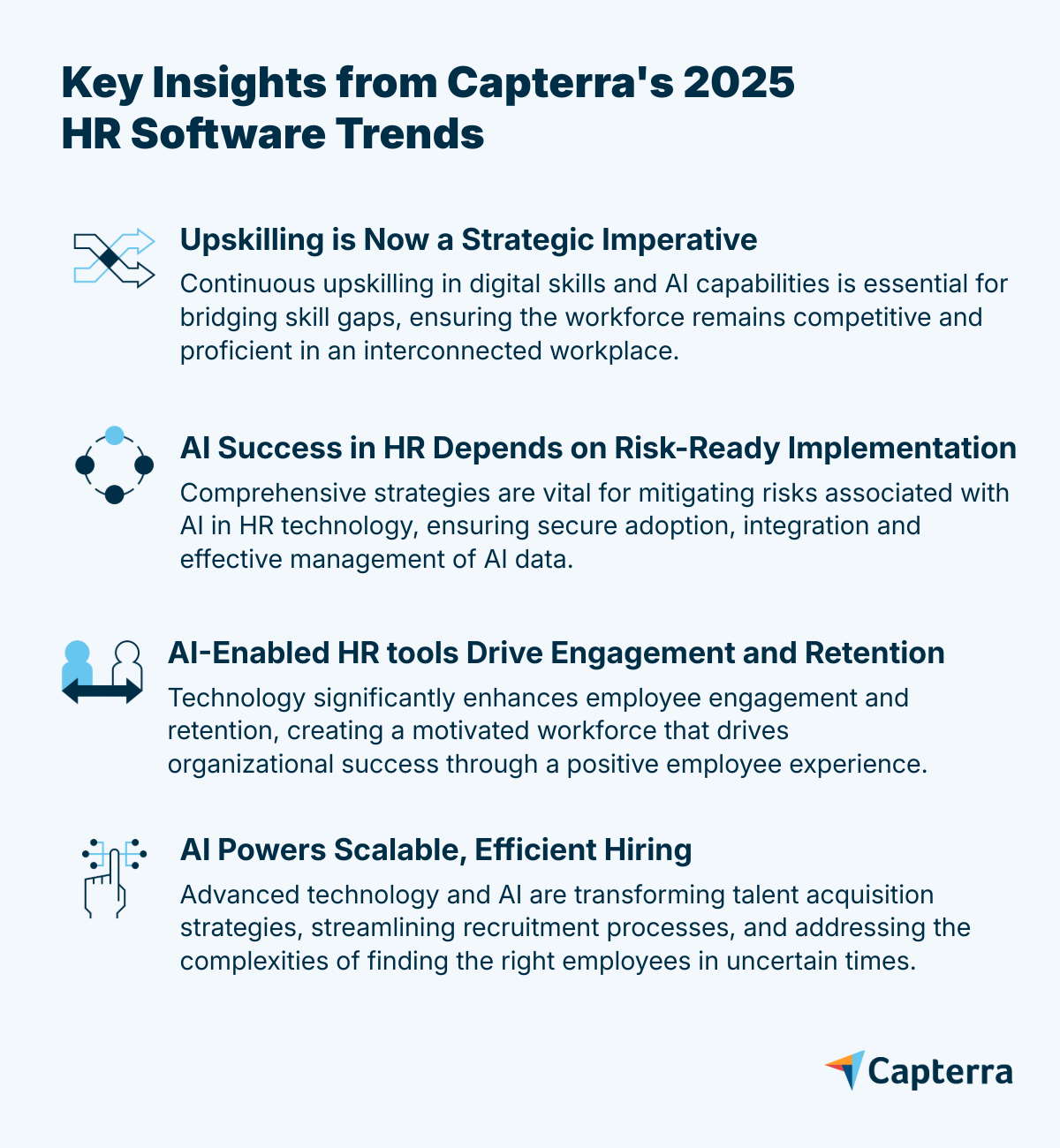
Key Insight 1: Upskilling is Now a Strategic Imperative for Indian HR
The challenge
Upskilling is critical in an increasingly interconnected work environment, and 49% of HR leaders say they expect to face this challenge in the next 12 months. Moreover, Indian organisations will also have to deal with complex software integration and enhance employees' AI skills.
According to Gartner’s report “Quick Pulse: Leader Sentiment on Skills Gaps,” [2] organisations are increasingly concerned about emerging skills gaps and their potential impact on performance and growth goals. 78% of HR leaders are worried about skills gaps at their organisations, and 56% are most concerned with deficiencies in digital skills. So, part of the challenge is also to identify where these gaps are.
"Identifying skills gaps in an organisation can be hard, and you have to do that work in order to understand where to focus your efforts with your training and learning programs."- Brian Westfall
What HR leaders in India tell us
- 49% cite training and upskilling current employees as the main operational challenge in the next 12 months.
- 55% indicate training new users on HR software as one of the main software-related challenges in the next 12 months.
- 83% expect that their training/upskilling costs will increase this year compared to last year.
- 53% highlight insufficient AI skills on staff as a challenge when adopting AI features.
Why it matters
Effective integration and skilled staff are crucial as companies juggle multiple systems, averaging four HR tools each. With AI boosting productivity, out-of-the-box software integration, and HR and AI expertise are essential for competitiveness.
Nearly three-quarters (72%) of Indian HR leaders indicated that their organisation already uses AI features in their HR software compared to the global average of 55%. Notably, Indian organisations' expectations of AI contribution to HR software have also increased the most in comparison to other surveyed countries, indicating a growing need for AI-specific skills.
In “Agentic and AI Kick-Starter for CHROs,” a Gartner report, HR leaders estimate that generative AI (GenAI) will impact 37% of the workforce and the way people work in the next two to five years. [3]
Crucially, nearly half (49%) of Indian HR leaders consider training resources critical when researching software even when the majority foresee an increase in costs in this field and are aware that they have to upskill their employees.
This mirrors a broader national challenge. The Digital India Initiative highlights the urgency of improving digital literacy, which is now reflected in HR where user training is essential to unlocking the full value of new technologies.
Additionally, national initiatives such as the Skill India Mission and the Pradhan Mantri Kaushal Vikas Yojana (PMKVY) highlight the urgent need to reskill the workforce in response to automation and AI adoption. Launched in 2015, Skill India aims to train over 400 million people in different skills by 2025, while PMKVY provides industry-relevant skill training to youth with a focus on employability and entrepreneurship. These programmes are particularly crucial as India navigates the twin challenges of rapid automation and the integration of AI across sectors.
For Indian HR leaders, aligning corporate upskilling strategies with these government-led frameworks not only helps bridge the digital skill divide but also ensures access to subsidies, standardized curricula, and certification pathways.
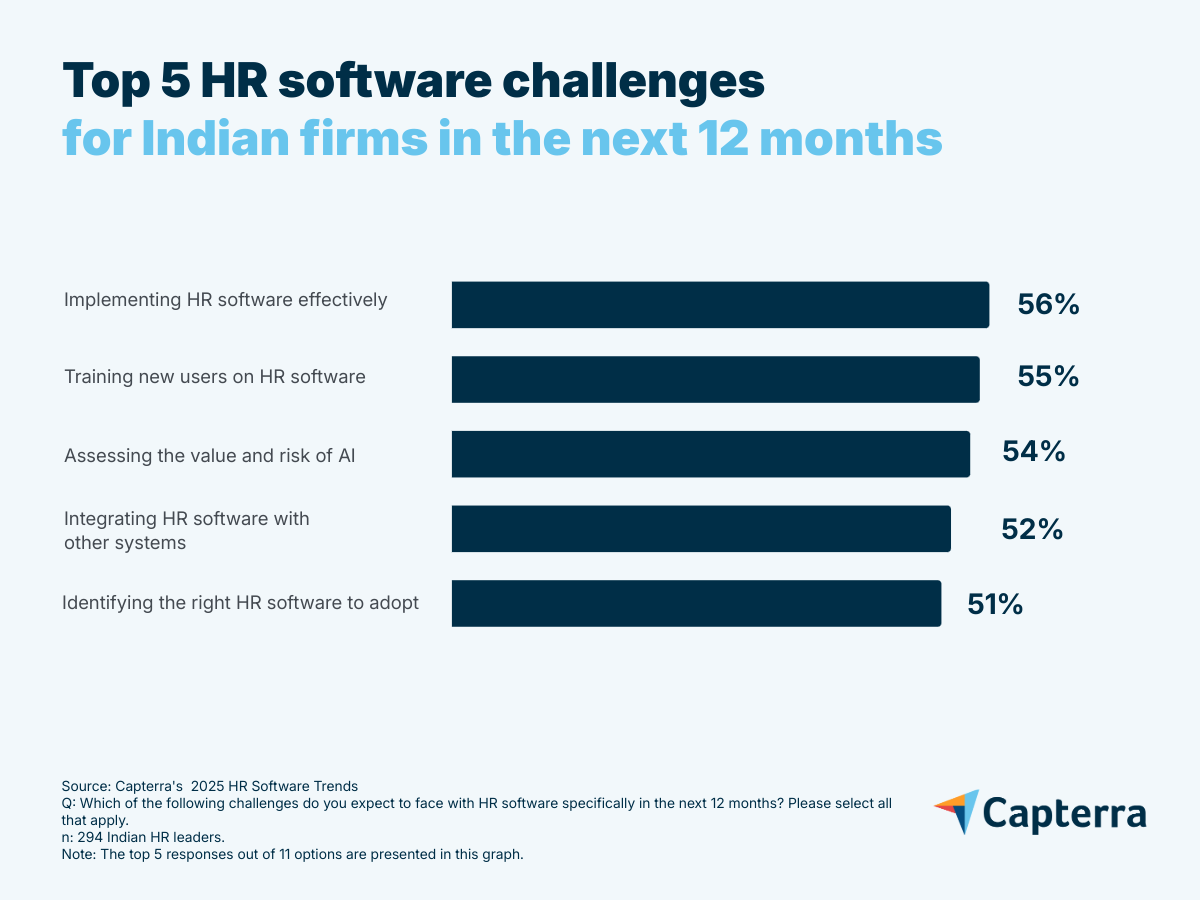
The opportunity
Organisations can address skills gaps and enhance productivity by focusing on upskilling initiatives and making sure they have effective software integrations, leveraging AI to support these efforts. In the current volatile and uncertain context, upskilling employees can be more productive and faster for companies than looking and hiring for specific roles.
"You see a lot of companies moving that budget from hiring more people towards upskilling, because that is going to be more cost-effective in the long run."- Brian Westfall
Recommendations
- Ensure current or upgraded software integrates with the company's HR tech stack.
- Leverage talent management/analytics to ensure smooth software integration and optimise AI capabilities.
- Develop comprehensive training programs: collaborate with leaders and software users to create ongoing upskilling initiatives.
- Invest in workforce training technology, focusing on integrations and AI features, and upgrade the software if needed.
- Regularly monitor the effectiveness of integrations and employee performance/skills.
Software solutions for HR leaders in India
Human resources management software: This type of tool centralises HR data and supports integration with other systems. AI features help automate data sync and enable real-time insights. 55% of HR leaders rate this type of software as critical to their HR operations.
HR/talent analytics: These tools help identify and address employee skills gaps. AI features can help design personalised upskilling paths. 54% of HR leaders rate this type of software as critical to their HR operations.
Learning management system (LMS): This kind of system supports ongoing training and upskilling in HR software and AI skills. AI features can help create content and templates and personalise the user experience. 52% of HR leaders rate this type of software as critical to their HR operations.
Key Insight 2: AI Success in HR Depends on Risk-Ready Implementation
The challenge
Over half of HR leaders in India cite effective software implementation (56%) and the assessment of AI value and risk (54%) among the top HR software concerns. Aside from having skilled staff, the main concerns regarding AI are obtaining quality data, understanding AI, and addressing privacy issues.
Organisations must understand the security risks associated with AI, as it will handle information provided from multiple sources (e.g., employees, clients, other software). Skilled employees and the right technology and processes will ensure data integrity. Brian Westfall [1], HR technology expert adds:
"You don't want to rush with AI. You want to implement and use those features when you're ready as an organisation because you don't want to have AI working off bad data. You don't want your users using AI for things that they shouldn't."
What HR leaders in India tell us
- 56% say effective HR software implementation is a challenge.
- 54% are concerned with assessing AI's value and risks.
- 67% consider security a critical feature when researching HR software to acquire and implement, while 58% report that security concerns triggered HR purchases last year.
- 50% of AI users say reducing security risks is a benefit of adopting HR software with AI features.
Why it matters
AI features must rely on high-quality data and compliance, making data protection and an understanding of AI decision-making crucial for minimising risks. Successful HR software implementation prevents disruptions and secures data. Efficient integrations protect privacy by reducing vulnerabilities. AI literacy is key to understanding how AI works.
Jonah Shepp, Senior Principal, Research, at Gartner, warns that AI, especially generative AI, poses privacy, intellectual property, and trust risks. HR leaders should address these, as employee behavior is key to preventing data leaks, which could have serious legal and reputational impacts. [5]
In India, concerns around AI risk are closely tied to national priorities. NITI Aayog’s National Strategy for AI, launched in 2018, outlines a roadmap for leveraging AI for inclusive growth across key sectors such as healthcare, agriculture, education, smart cities, and smart mobility. The strategy promotes the concept of “AI for All,” emphasizing not only innovation and economic growth but also ethical considerations, transparency, and accountability. It advocates for responsible and inclusive adoption, urging HR leaders to balance innovation with safeguards around jobs, privacy, and ethics.
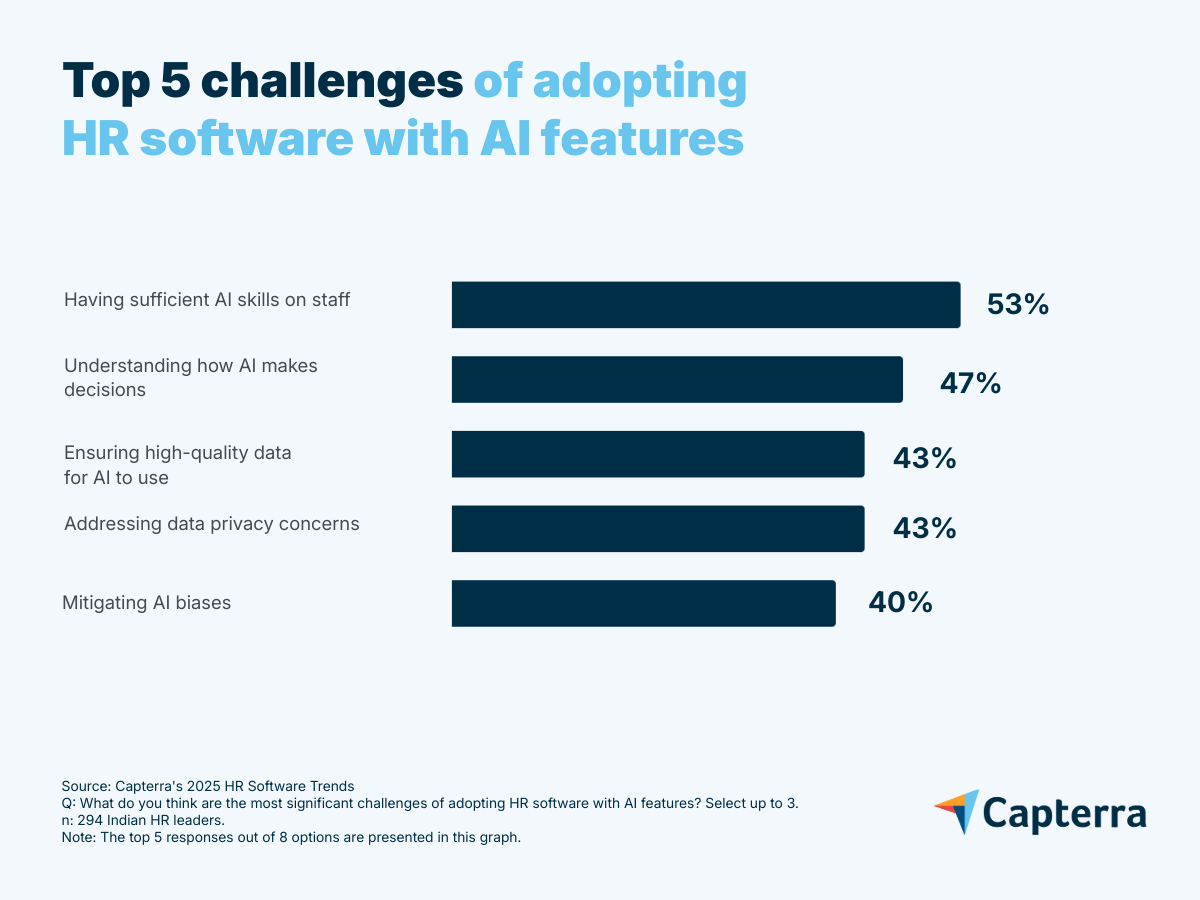
The opportunity
Implementing software properly, maintaining data quality, and understanding how AI works all help to mitigate risks of AI. HR software with AI features helps reduce security risks, but effective data privacy and management are also crucial for protecting sensitive information and ensuring compliance.
Eser Rizaoglu and Stephanie Clement, both Senior Director Analysts, state in Gartner’s “Agentic and AI Kick-Starter for CHROs” report [3] that cultivating AI literacy—the knowledge and skills to effectively work with AI—is essential for successfully scaling AI within an organisation. Without it, organisations are unlikely to achieve value creation with AI.
Recommendations
- Ensure staff effectively use HR software integrations and understand AI functionalities; implement training programs if necessary.
- Conduct comprehensive data audits to verify data quality, correct usage, and alignment with business expectations.
- Revise data policies to ensure high-quality input and compliance with privacy rules, crucial for both general and AI-enhanced systems.
- Upgrade security features in HR software to safeguard employee data and manage AI-related risks; consider changing the product if necessary.
- Establish clear usage guidelines and regularly assess software functionality and ease of use to improve productivity and reduce user errors.
Software solutions for HR leaders in India
HR/talent analytics: Leverage these tools to help analyse and improve employee data governance policies aligned with AI data usage. AI features can generate role summaries and risk insights to help organisations quickly evaluate whether user-role assignments are appropriate and compliant. 54% of HR leaders rate this type of software as critical to their HR operations.
Learning management system (LMS): Use LMS to train employees on data collection and AI usage. AI can personalise learning paths based on employee roles and knowledge gaps, ensuring targeted upskilling in data and AI literacy. 52% of HR leaders rate this type of platform as critical to their HR operations.
Data management software: Manage and ensure the quality of data used for the HR software and AI applications. AI features can automate data cleansing and validation processes, reducing human error and ensuring high-quality inputs for AI systems.
Data privacy software: Monitor and enforce adherence to data privacy regulations. AI features help in real-time compliance tracking and automated enforcement of privacy policies.
Key Insight 3: AI-Enabled HR Tools Drive Engagement and Retention
The challenge
Boosting employee engagement and retention is a top HR priority for HR leaders in India. Identifying the employee experience areas to improve is key, as it drives engagement and, in turn, increases retention.
"Engagement and retention are always going to be one of the biggest priorities for any HR department in any organisation. It comes down to really looking at the entire employee experience. Because employees will leave an organisation for a lot of different reasons."- Brian Westfall
Using and efficiently integrating tools like compensation software, employee engagement, and benefits administration is crucial for creating a motivated and committed workforce.
What HR leaders in India tell us
- 48% identify improving employee engagement, and 34% cite retaining employees as HR challenges for this year.
- 57% of AI features users in HR software report that they help increase employee satisfaction or engagement, compared to 49% of non-users of AI features.
- 55% of AI features users in HR software report that they help increase employee retention, compared to only 38% of non-users of AI features.
Why it matters
Retaining and engaging skilled employees is key as they are valuable assets who not only perform well but can also train others and drive organisational success. Losing them would mean incurring additional recruitment and training costs and efforts. It is essential to focus on strategies that keep key employees motivated and committed by enhancing their overall experience within the organisation.
"Engagement and retention are always going to be a priority, right? When times are good, there are many job opportunities that give employees an excuse to leave one organisation for another. And then, when industries are struggling, that's also an excuse for employees to leave that industry. So companies are always hyper-aware of how to engage and retain their employees."- Brian Westfall
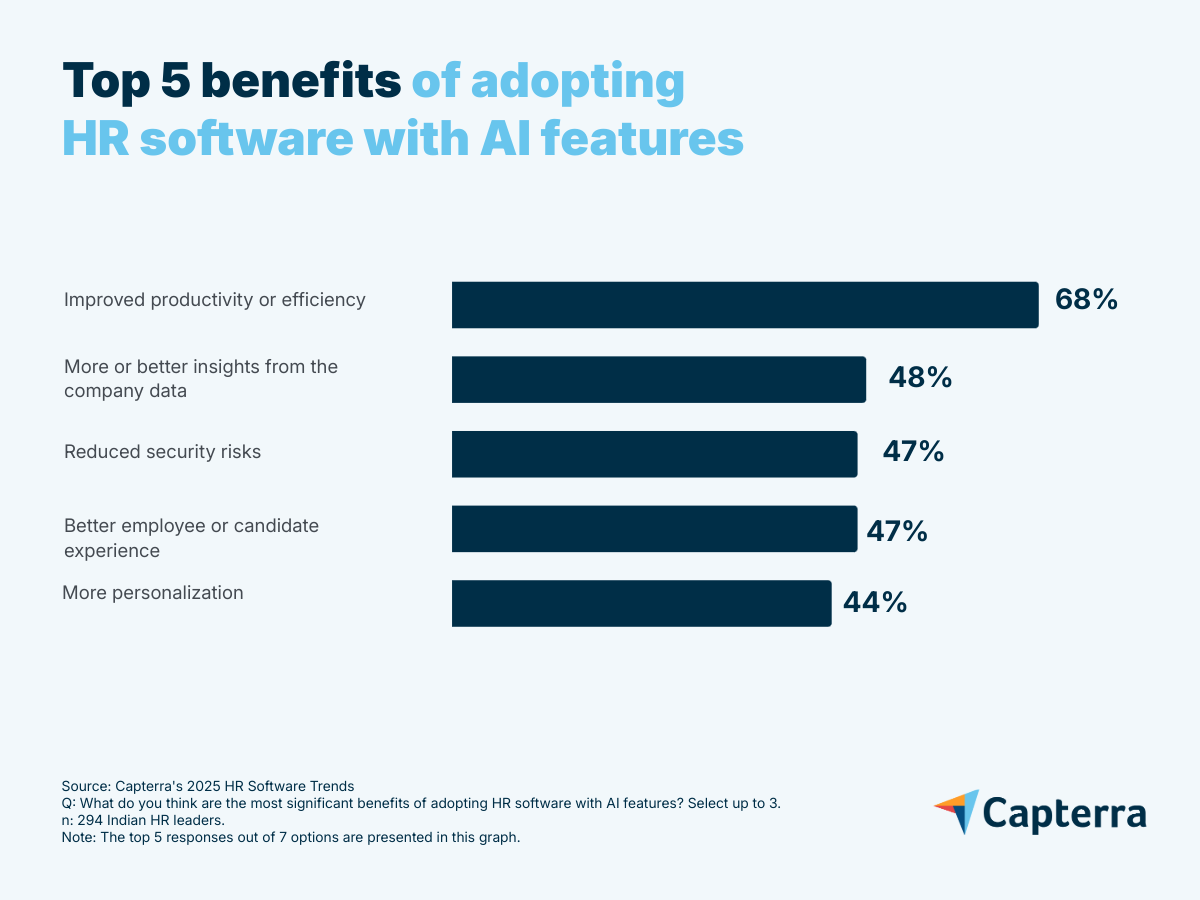
The opportunity
By leveraging technology, organisations can significantly enhance employee engagement and retention. Adopting HR software has led to higher satisfaction and retention rates in India, while AI features enable the software to provide better insights and, ultimately, enhance employee experience.
Recommendations:
- Brian Westfall recommends regularly conducting surveys to assess engagement levels, pinpoint areas for improvement, and continuously monitor the employee experience (benefits, learning, and growth opportunities). This can help develop plans to enhance employee engagement.
-
According to Gartner’s “2025 HR Technology Employee Experience Bullseye” report [4], to improve employee experience, HR leaders should:
- Identify which HR tasks employees prefer to handle in person versus through self-service platforms to better meet their needs and enhance their experience.
- Invest in internal career sites and talent marketplaces to support career growth and retention.
- Focus on user-friendly HR tech to conveniently gather employees' sentiment.
- Promote well-being tool adoption by tailoring offerings to generational preferences, with a focus on mental well-being tools for millennial and Gen Z employees.
-
To support employee retention, HR leaders can leverage the following strategies:
- Use performance management software to analyse employee performance, recognise and reward them accordingly with compensation management tools.
- Use benefits administration software to offer personalised advantages that meet employee needs and maintain work-life balance.
- Leverage talent management software to provide growth opportunities, encourage skill development, and foster career advancement, keeping top talent committed. Employees are more likely to stay engaged with the organisation if the management supports their career paths and helps them develop their skills.
Software solutions for HR leaders in India
Compensation management software: Design competitive pay structures to retain skilled employees. AI can help you benchmark compensation against market data and predict turnover risks based on pay satisfaction. 51% of HR leaders rate this type of software as critical to their HR operations.
Employee engagement software: Foster morale and recognise employee achievements. AI-driven nudges and recognition algorithms can help managers engage employees more consistently. 50% of HR leaders rate this type of software as critical to their HR operations.
Survey software: Collect employees' feedback on what they are missing to feel more engaged. AI features can analyse sentiment and discover patterns in employee concerns.
Key Insight 4: AI Powers Scalable, Efficient Hiring in India
The challenge
Finding the right employees in complex times requires innovative approaches. With recruiting costs rising and a demand for skilled professionals, organisations must adapt their strategies using technology enhanced with AI, which aids in talent analytics, volume of applications, candidate experience, and better recruitment outcomes.
Brian Westfall, notes that as the job market shifts, there will be a surge in applicants for each job opening, adding complexity to the screening and hiring process. He highlights that recruiting involves more than just identifying top candidates; it's about engaging with job seekers to prevent pipeline dropouts and ensuring the best candidate experience possible throughout the process.
What HR leaders in India tell us
- 46% identify hiring skilled professionals as one of the top HR challenges this year.
- 90% expect to increase their workforce in the next 12 months.
- 76% foresee recruiting costs increasing compared to last year.
- 39% think that HR analytics is the process that benefits most from AI.
Why it matters
Efficiency is critical when you have less budget and fewer resources, and that's where software can help. Most notably, nine in ten Indian HR leaders anticipate that their organisation’s workforce will grow in the next 12 months, but 49% consider recruiting software critical, despite the process being one of the top challenges for organisations.
However, it is not only about having the technology. HR tools with AI features can help organisations recruit more efficiently and enhance the recruiter-candidate relationship, but soft skills are also needed to engage, connect, and provide a personalised experience to candidates.
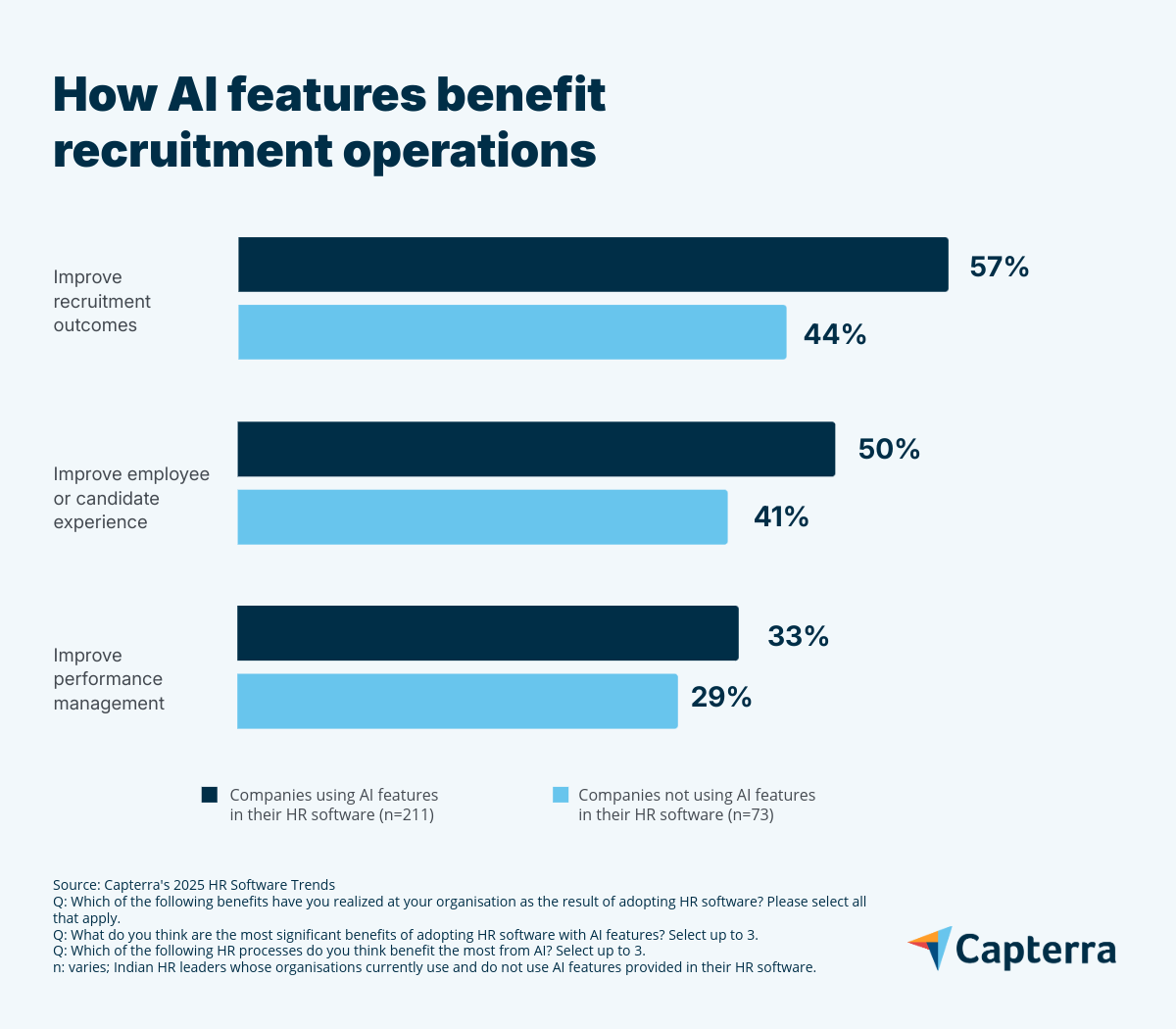
The opportunity
AI-driven recruiting improves hires by automating routine tasks and freeing recruiters' time to build quality candidate relationships. It optimises the identification of effective job posting sources and the selection of compatible candidates.
"AI can really help take over some of the more routine tasks. For example, the first initial screening interview, where you're getting the basic details from these job applicants. We're seeing chatbots taking over this step, which is really helpful, because the recruiters can then focus on those more tailored experiences for candidates further down in the pipeline."- Brian Westfall
Recommendations:
- Upgrade recruiting software/ATS with AI features to refine and speed up the early stages of applicant screening.
- Implement AI features in performance management to enhance decision-making, personalise employee development, and drive continuous improvement.
- Focus on candidate experience by continuously training your recruiters in soft skills.
-
When implementing AI in recruitment, consider:
- Use AI to support the process, not replace it: candidates still value human interaction and decision-making.
- Be transparent about how AI is used in the hiring process.
- Prioritise candidate experience by offering the option to connect with a human recruiter.
Software solutions for HR leaders in India
Performance management software: These tools help the analysis of employee performance data to identify high-potential talent and align individual goals with organizational objectives. AI features enhance performance evaluations by delivering predictive insights and automating data analysis. 50% of HR leaders rate this type of software as critical to their HR operations.
Recruiting software and ATS: Both software streamline the talent acquisition process, from sourcing to selection. AI features further improve efficiency by automating resume screening and enhancing candidate matching. 49% of HR leaders rate these types of software as critical to their HR operations.
Adapting HR to India’s Digital and AI-Driven Future
The future of HR in India will be shaped by how effectively organisations respond to rapid technological change and evolving workforce expectations. As AI adoption accelerates and digital tools become more embedded in HR operations, success will depend on how well leaders prioritise upskilling, ensure data integrity, and align technology with human-centric values. Those who act on these trends—grounded in India’s unique challenges and opportunities—will be best positioned to attract, develop, and retain top talent in an increasingly complex and competitive environment.
Note: The applications mentioned in this article are examples to show a feature in context and are not intended as endorsements or recommendations.
Sources
- Brian Westfall, LinkedIn
- Quick Pulse: Leader Sentiment on Skills Gaps, by Trisha Rai, February 2025, Gartner
- Agentic and AI Kick-Starter for CHROs, by Eser Rizaoglu and Stephanie Clement, June 2025, Gartner
- HR Technology Employee Experience Bullseye Report, 2025, by Nini Longoria, April 2025, Gartner
- HR Leaders Must Understand the Opportunities and Risks of Adopting AI and GenAI Technologies: Act Now to Prepare for the Future of Work, by Jonah Shepp, December 2024, Gartner
*Methodology
Capterra's 2025 HR Software Trends Survey was conducted in April 2025 among 3,256 respondents in Australia (n=278), Brazil (n=300), Canada (n=289), France (n=300), Germany (n=300), India (n=294), Italy (n=300), Mexico (n=300), Spain (n=300), the U.K. (n=296), and the U.S. (n=300). The goal of the study was to understand the HR software that companies are buying, their benefits and challenges, and the impact of AI on HR. Respondents were screened for employment at companies with more than one employee, working in management-level roles or above. Respondents were also confirmed to be at least partially responsible for HR software purchase decisions within their organisation.